Enterprise Consent Platform — Admin, Config & Compliance
- Client
- Securiti.ai (acq. by Veeam, $1.73B)
- Role
- Sole Product Designer — Consent
- Timeline
- 2022 — Present
NDA-protected case study
This work is protected under NDA. Request the password via email or LinkedIn.
No password? Email me to request access →
Overview
The challenge
Enterprise compliance teams managing consent across 20+ countries need powerful configuration — but power users can't afford a steep learning curve when the stakes involve regulatory compliance and contracts worth hundreds of thousands of dollars a year.
I owned the entire enterprise-facing side of the consent platform: how clients set up consent experiences, how they monitor compliance, how they read their data — and the design system that made all of it consistent and maintainable.
Context & scale
- $1.73B Securiti acquired by Veeam — this was a core product
- Fortune 500 Top US airlines, global retail brands, international financial institutions
- $300–400K Per year enterprise contract value
- 20+ Countries managed through the admin platform
My role
Sole product designer for all consent products at Securiti. For the enterprise platform specifically, I owned the full scope: admin configuration, compliance reporting, the preference center experience, and the internal component library that all of these shared.
Collaborated with compliance and legal stakeholders, my design manager, and engineering. On the consent product, every design decision is mine.
Products I designed
Research
Key insights
- Compliance managers weren't configuring consent for UX — they were configuring for audit readiness. Every field, toggle, and label in the admin had to map to a defensible legal position.
- Existing tools gave power users too much rope. Open-form configuration meant every client implemented things differently — leading to inconsistent consent records and failed audits.
- Reporting was the most requested missing feature. Clients needed to prove compliance — not just implement it. Dashboards weren't a nice-to-have; they were a renewal driver.
- Onboarding took too long. Enterprise clients were self-configuring a complex platform against tight compliance deadlines — without UX guardrails, setup errors appeared downstream in live consent flows.
Constraints I designed within
- High-ticket, high-trust: any UX error risks a compliance audit failure for the client
- Power users: compliance managers and legal teams, not casual consumers
- Multi-jurisdiction: each client may operate across GDPR, CCPA, and regional laws simultaneously
- Design system scale: components used across multiple product teams beyond consent
Design
01 / Design decision
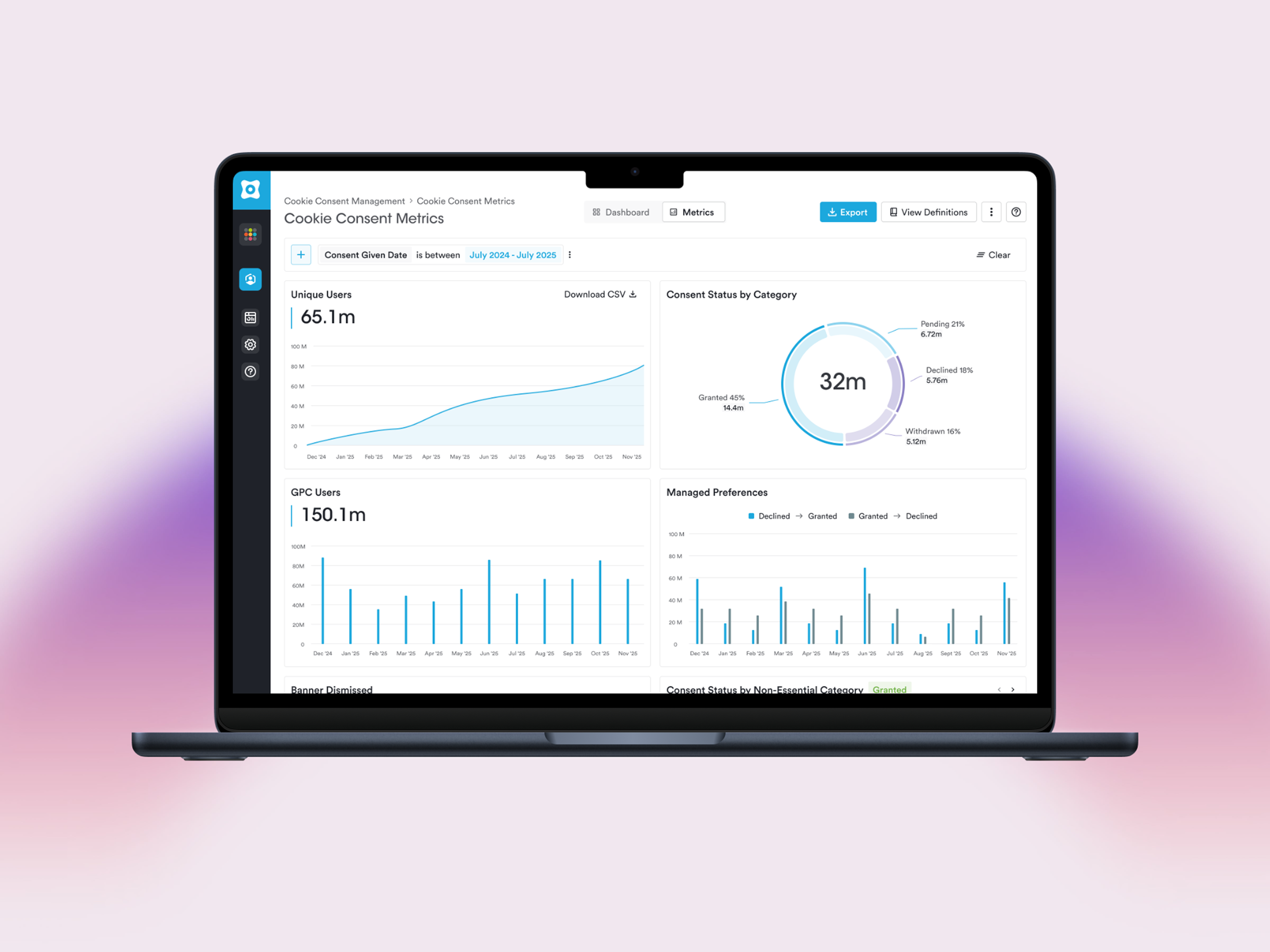
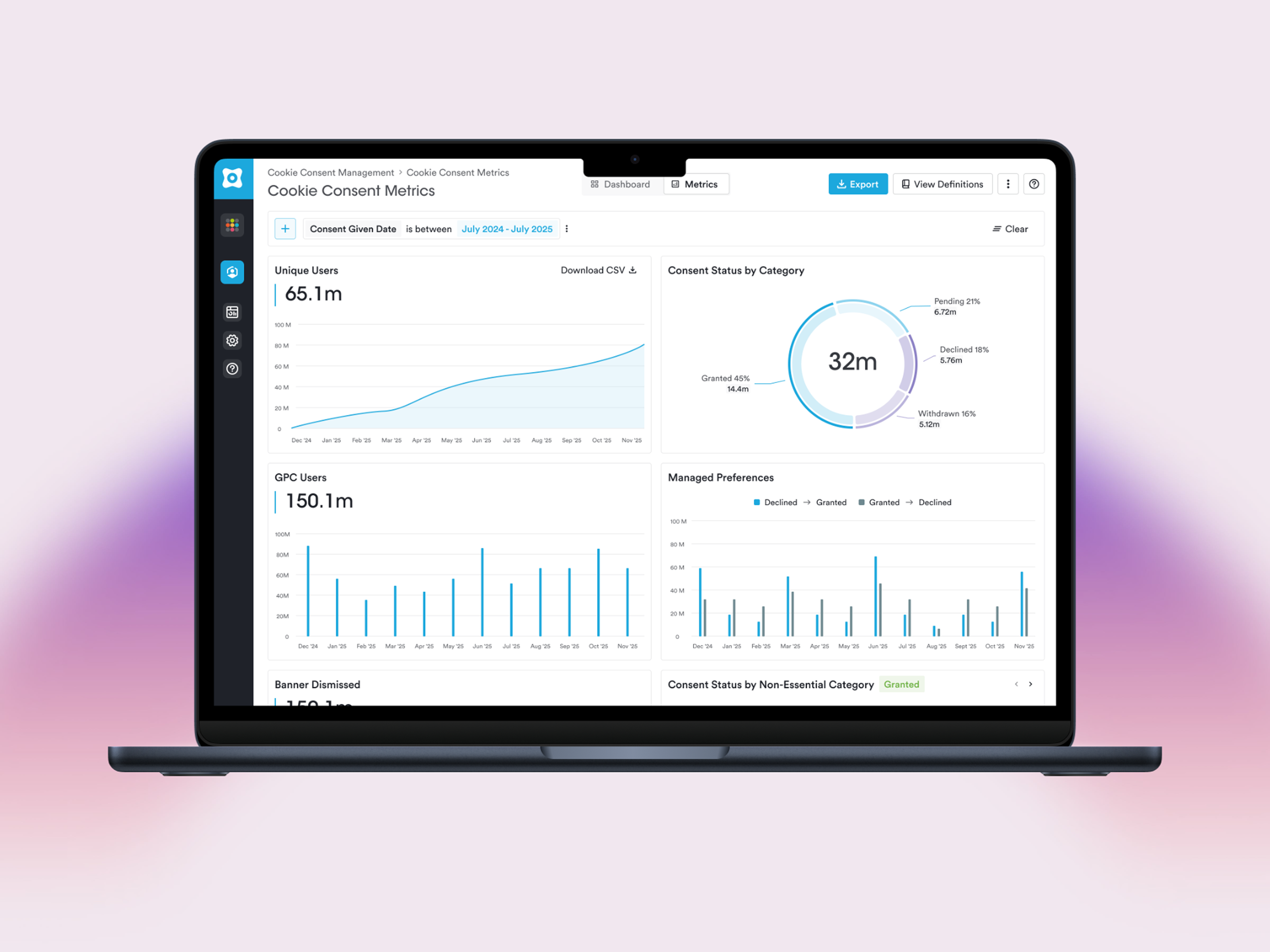
Compliance reporting as a first-class product surface
Most consent platforms buried reporting behind export functions and raw data tables. But for enterprise compliance teams, the ability to prove consent — to an auditor, to a regulator, to a board — is the actual product. I designed the compliance reporting dashboard as a primary surface, not an afterthought: consent granted vs. declined by category, unique user counts, and breakdown by jurisdiction, all readable at a glance without requiring a data export. The goal was to make audit-readiness visible in under 30 seconds.
02 / Design decision
Surfacing usage metrics to close the feedback loop for clients
Enterprise clients were deploying consent banners and preference centers with no visibility into how those experiences performed in the wild. Usage metrics — interaction volume, trend lines, banner-level breakdown — gave compliance and product teams the feedback loop they needed to iterate on their consent configuration. I designed the metrics surface to be legible to non-technical stakeholders: no raw event data, no SQL exports. Just the signal that tells a compliance manager whether their consent flow is working or eroding user trust.
03 / Design decision
[Third decision title]
[Rationale]
Before & after
Final screens
Component library
[Describe the component library — scope, decisions made, how it served multiple teams, what made it scale across the consent product suite.]
Outcome
[Write what shipped, what improved, and how it was received. Did client onboarding get faster? Did compliance audit pass rates improve? Did the design system reduce engineering time? Use numbers you can back up — never estimate.]
$1.73B
Securiti acquired by Veeam — this platform was a core product
$300–400K
Per year enterprise contract value
[X]
[Your specific outcome metric]